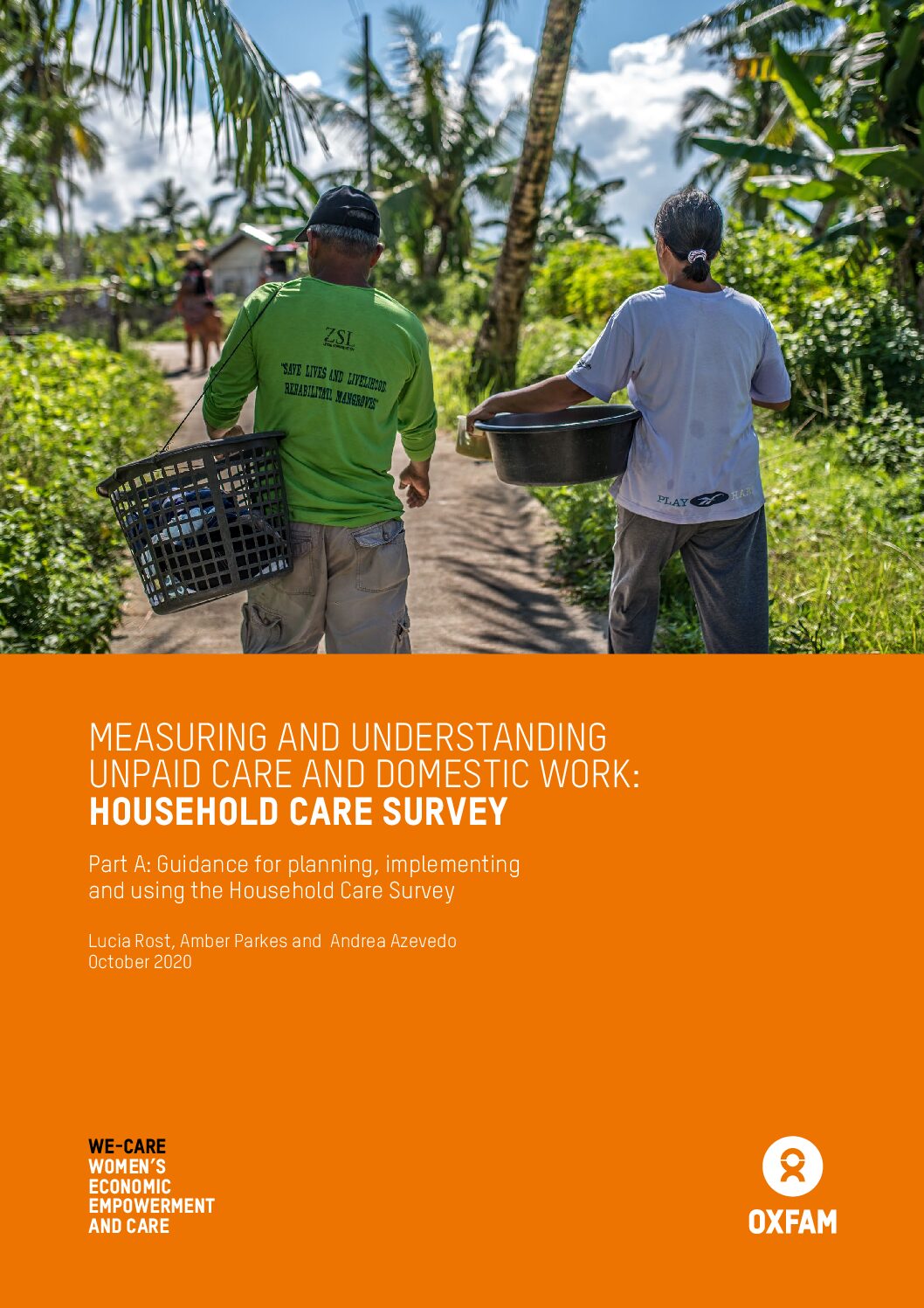
MEASURING AND UNDERSTANDING UNPAID CARE AND DOMESTIC WORK: HOUSEHOLD CARE SURVEY
This toolkit provides guidance to those who are interested in Oxfam’s Household Care Survey (HCS) methodology, which was developed by Oxfam as part of the WE-Care initiative1 (see box). The toolkit is designed to be used by development practitioners, policy makers, employers, academics and researchers. The HCS gathers data on factors associated with higher and lower hours of unpaid care tasks to support efforts to transform the provision of unpaid care and domestic work (UCDW). The HCS is a quantitative survey tool that aims to generate evidence on how women, men and children spend their
time, how care is provided, by whom, and which are the main factors that affect people’s responsibilities for UCDW. It can be used to understand how the division of labour in care work is shaped by household characteristics, decision-making processes, social norms, access to time- and labour-saving equipment, public services and government schemes. The HCS has been used, for example, as a baseline for context-specific evidence on UCDW to evaluate changes in how care is provided due to projects, or to develop new policies. Care and domestic work underpins all our lives, and recognizing it is essential for any development initiative. The HCS methodology can be integrated into different projects with different objectives. While the methodology was first developed to be used in rural communities in low-income countries, it can be adjusted to other contexts.