Care Policy

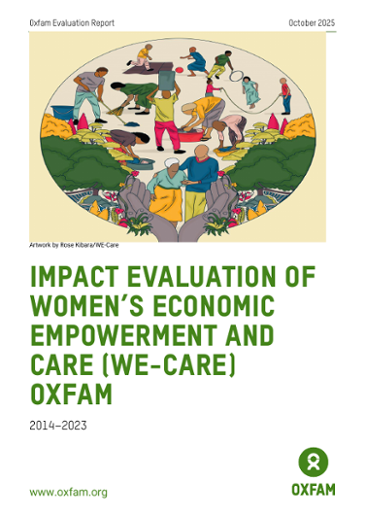
Impact Evaluation of Women’s Economic Empowerment and Care (WE-CARE) Oxfam 2014-2023

The Women’s Economic Empowerment and Care: Evidence for Influencing (WE-Care) program, launched by Oxfam in 2014, set out to confront one of the most persistent and invisible barriers to gender equality: Unpaid Care and Domestic Work (UCDW). Over nearly a decade, the program sought to recognize, reduce, and redistribute the burden of care work that […]
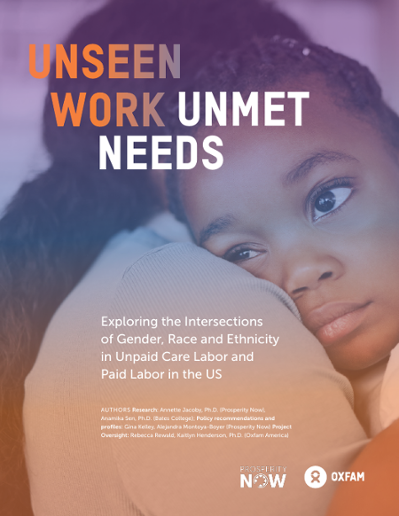
Unseen Work, Unmet Needs: Exploring the intersections of gender, race and ethnicity in unpaid care labor and paid labor in the U.S.

Oxfam America and Prosperity Now have embarked on a comprehensive joint research project to explore the dynamics of women’s paid and unpaid labor in the US, particularly for women of color, who are disproportionately affected by the dual impact of paid work and unpaid care responsibilities. This report adopts an intersectional lens to delve into […]

Reframing Narratives Around Care and Informal Work in Kenya, the UK and Zimbabwe: A synthesis of national research

This research study across three countries – Kenya, UK, and Zimbabwe – was carried out to identify the dominant narratives that influence public perceptions of care and informal work. It enabled the researchers to develop and test new narratives that could be used to improve public attitudes towards care and informal work. Creating new stories […]

Measuring Social Norms on Unpaid Care Work: Insights from Oxfam’s household care surveys

This paper describes the approach to measuring social norms related to unpaid care work in Oxfam’s Household Care Survey (HCS), and discusses benefits and limitations of this approach. The HCS is a quantitative research tool developed through Oxfam’s Women’s Economic Empowerment and Care (WE-Care) programme. It measures adults’ and children’s time spent on unpaid care work […]

Topic

Areas Covered

Care Policy Scorecard: A tool for assessing country progress towards an enabling policy environment on care

Care work needs to be recognized, shared and invested in now more than ever given that progress on Sustainable Development Goal (SDG) 5 – Achieve Gender Equality – is behind target and COVID-19 has created additional challenges with increases in care work, poverty and precariousness that could reverse gains made in gender equality and poverty […]

Topic

Areas Covered

The World Bank in Asia: An assessment of COVID-19-related investments through a care lens. Care-responsive investments and development finance

International financial institutions (IFIs) have been playing a vital role in the response to  the COVID-19 pandemic and will play an equally important role in the recovery and ‘build back anew’ agenda. This is particularly true of the World Bank Group (WBG), given its high volumes of committed investments across sectors, especially in low-income and […]

Quicklinks

WE-Care

Gender Equality