Gender Equality

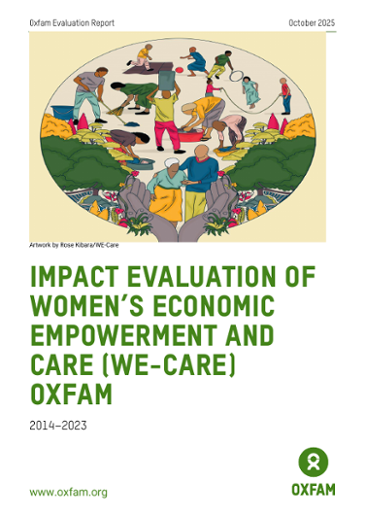
Impact Evaluation of Women’s Economic Empowerment and Care (WE-CARE) Oxfam 2014-2023

The Women’s Economic Empowerment and Care: Evidence for Influencing (WE-Care) program, launched by Oxfam in 2014, set out to confront one of the most persistent and invisible barriers to gender equality: Unpaid Care and Domestic Work (UCDW). Over nearly a decade, the program sought to recognize, reduce, and redistribute the burden of care work that […]
Care & the Platform Economy in the UK: A Mapping Exercise

In the UK and globally, in-home domestic childcare and adult care services are increasingly being provided via digital platforms, with significant implications for in-home/domestic care workers.This paper maps what we already know about this phenomenon and identifies knowledge gaps that could be filled through focused research in support of influencing initiatives aimed at improving rights […]

Unseen Work, Unmet Needs: Exploring the intersections of gender, race and ethnicity in unpaid care labor and paid labor in the U.S.

Oxfam America and Prosperity Now have embarked on a comprehensive joint research project to explore the dynamics of women’s paid and unpaid labor in the US, particularly for women of color, who are disproportionately affected by the dual impact of paid work and unpaid care responsibilities. This report adopts an intersectional lens to delve into […]

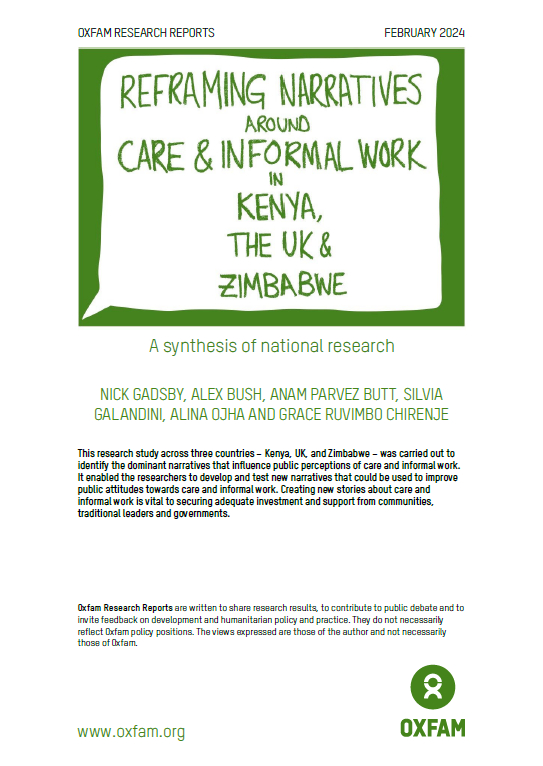
Reframing Narratives Around Care and Informal Work in Kenya, the UK and Zimbabwe: A synthesis of national research

This research study across three countries – Kenya, UK, and Zimbabwe – was carried out to identify the dominant narratives that influence public perceptions of care and informal work. It enabled the researchers to develop and test new narratives that could be used to improve public attitudes towards care and informal work. Creating new stories […]

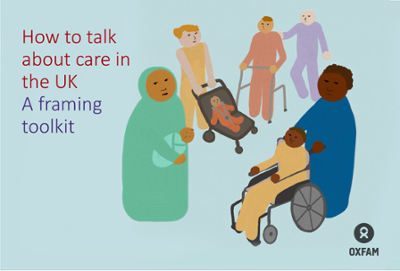
How to Talk about Care in the UK: A framing toolkit

Across the UK, many people providing paid and unpaid care – including parents and guardians of children, paid care workers, and unpaid carers – experience poverty, and great physical and emotional pressures. This is because the care they provide remains largely taken for granted and is not properly supported by governments and wider society. In […]

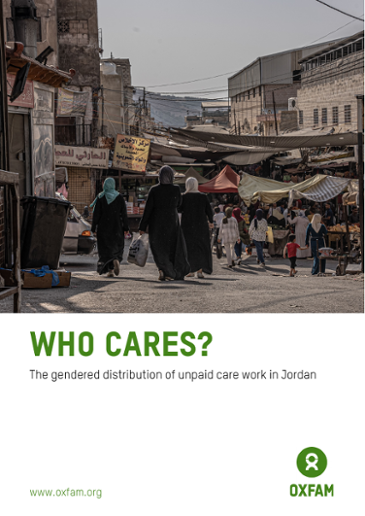
Who cares? The gendered distribution of unpaid care work in Jordan

Pervasive global norms position men as breadwinners and women as caregivers; in every country in the world, women do more unpaid care work than men. This paper explores the gendered distribution of unpaid care work in Jordan, where female labour market participation is among the lowest in the world. It presents the key findings of […]

The role of care and the local economy in women’s labour force participation: evidence from Mexico and Colombia in the pandemic era

Women face disproportionate care burdens on their time because of traditional gender roles, lack of public policies supporting them and the lack of government services for satisfying society’s care needs. This unequal distribution of care responsibilities reduces their opportunities to fully participate in labour markets. We argue that all else equal, women’s physical proximity to […]

Caring in a changing climate: Centering care work in climate action

The global care crisis is being exacerbated by the global climate emergency, with interlocking impacts that threaten lives and livelihoods in all parts of the world. These impacts are particularly severe among rural livelihoods in low-income countries. Climate change intensifies the work involved in caring for people, animals, plants, and places. It reduces the availability […]

The World Bank in Asia: An assessment of COVID-19-related investments through a care lens. Care-responsive investments and development finance

International financial institutions (IFIs) have been playing a vital role in the response to  the COVID-19 pandemic and will play an equally important role in the recovery and ‘build back anew’ agenda. This is particularly true of the World Bank Group (WBG), given its high volumes of committed investments across sectors, especially in low-income and […]

Quicklinks

WE-Care

Gender Equality