Asia

Inspiring Governments to be Care Champions: How advocates are Strengthening Care Systems Around the World

Paid and unpaid care work is essential to our economy and society, covering activities such as childcare, elder care, and support for individuals with disabilities or illnesses. These efforts are vital for human well-being and form the foundation for all other work. The COVID-19 pandemic highlighted our reliance on care work and its supporting infrastructures, […]
Topic

Areas Covered

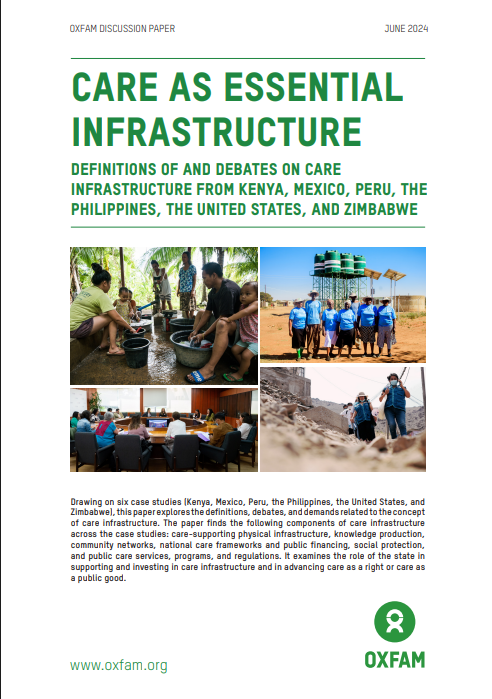
Care as Essential Infrastructure: Definitions of and debates on care infrastructure from Kenya, Mexico, Peru, the Philippines, the United States, and Zimbabwe

Drawing on six case studies (Kenya, Mexico, Peru, the Philippines, the United States, and Zimbabwe), this paper explores the definitions, debates, and demands related to the concept of care infrastructure. The paper finds the following components of care infrastructure across the case studies: care-supporting physical infrastructure, knowledge production, community networks, national care frameworks and public […]

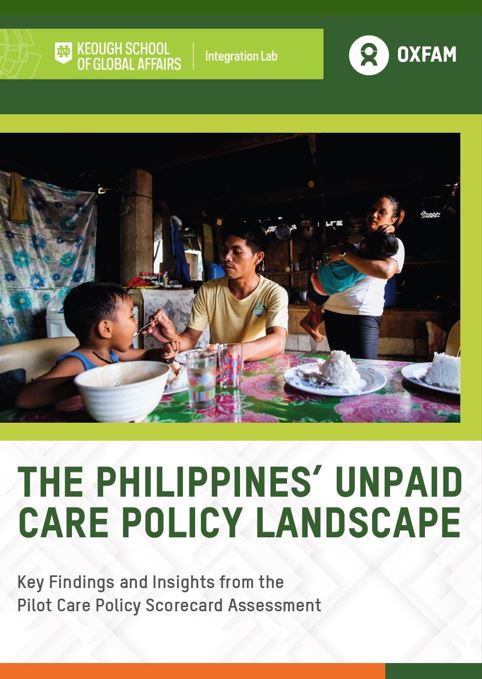
The Philippines’ Unpaid Care Policy Landscape: Key Findings and Insights from the Pilot Care Policy Scorecard Assessment

Unpaid care and domestic work (UCDW) is performed around the world disproportionately by women and girls. Oxfam is committed to alleviating this burden of unpaid care and domestic work and to elevating the discourse on the value of UCDW’s contribution to society. As part of its continuing efforts to contribute to enhanced public policy around […]

CARE AS ESSENTIAL INFRASTRUCTURE : The Case of the Philippines

The ongoing COVID-19 pandemic has revealed the dependence of our societies on systems of care and caregiving to survive and thrive. This support system, however, has been mostly unpaid if not totally unrecognized for far too long. Its resulting negative effects have disproportionately affected women and girls around the world, especially in the Global South. […]

Topic

Areas Covered

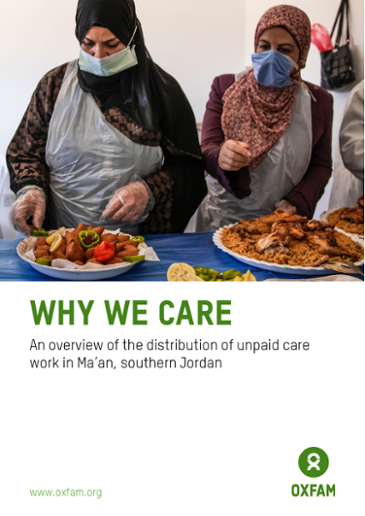
Who cares? The gendered distribution of unpaid care work in Jordan

Pervasive global norms position men as breadwinners and women as caregivers; in every country in the world, women do more unpaid care work than men. This paper explores the gendered distribution of unpaid care work in Jordan, where female labour market participation is among the lowest in the world. It presents the key findings of […]

CARE WORK MATTERS: A Participatory Approach to Advocating for the Recognition and Redistribution of Unpaid Care and Domestic Work in Local Legislation

In the Philippines, a country extremely vulnerable to natural hazards and climate-related disasters, which exacerbate poverty and preexisting social vulnerabilities, women and girls do up to five to six times as much unpaid care and domestic work as men. There is growing recognition that the billions of hours of the most essential work, including heavy […]

Topic

Areas Covered

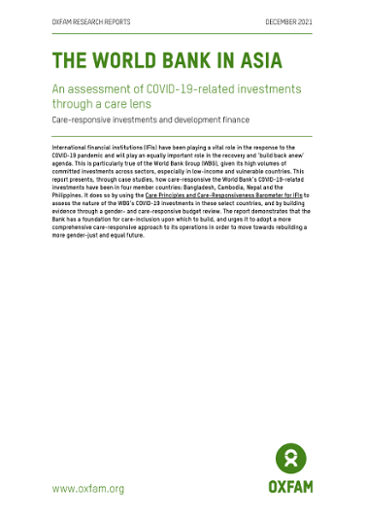
The World Bank in Asia: An assessment of COVID-19-related investments through a care lens. Care-responsive investments and development finance

International financial institutions (IFIs) have been playing a vital role in the response to  the COVID-19 pandemic and will play an equally important role in the recovery and ‘build back anew’ agenda. This is particularly true of the World Bank Group (WBG), given its high volumes of committed investments across sectors, especially in low-income and […]

Quicklinks

WE-Care

Gender Equality